- Janus Luckly Newsletter
- Posts
- The Choice We Make
The Choice We Make
Walking with Edith Eger, remembering Auschwitz, and refusing the easy slide into cruelty.

Janus Lucky
January 20, 2026
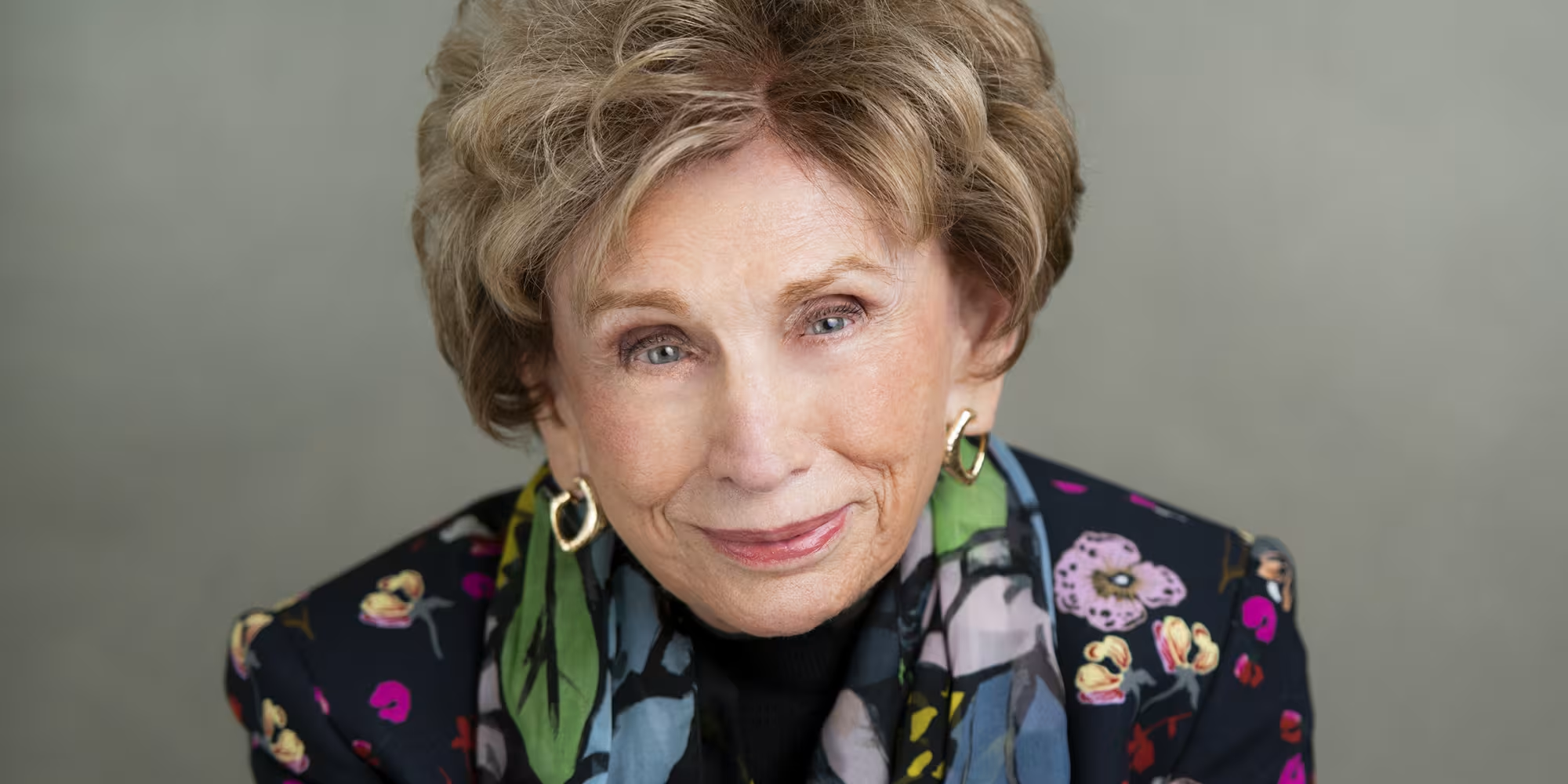
Dr Edith Eger. Photo by Jordan Engle.
For the past few days, after finishing Harry Potter and the Philosopher’s Stone (remember last week’s newsletter), I’ve been out walking with a new audiobook in my ears — and The Choice: Embrace the Possible by Edith Eger has properly knocked the wind out of me. Not in a “that was a good book” way, but in the rarer way a book rearranges your inner furniture.
It gives you the kind of perspective-shock I’ve only really felt with Viktor Frankl’s Man’s Search for Meaning. Different voices, different lives, but the same hard-won truth running underneath from the worst possible place on earth, Auschwitz: even when everything is taken, something essential remains — the human capacity to choose one’s response.
From happiness to Hell on earth
Eger was a Hungarian and was born in 1927. She was Jewish teenager deported to Auschwitz in 1944. She recounts her childhood in Hungary, then the rupture of deportation, the murder of her parents, and the relentless machinery of starvation, brutality, forced labour, and the death marches that followed, before liberation by American troops.
But this is not only a survival memoir. After the war, she marries, returns briefly to communist Hungary, then escapes with her husband and child to the United States, where she slowly rebuilds her life, studies psychology, and becomes a therapist specialising in trauma.
What makes the book so profoundly useful (and not “only” profoundly moving) is Eger’s insight that suffering isn’t a competition and that prisons aren’t always made of barbed wire.
Guilt, shame, resentment, self-hatred — these can become psychological camps, and she threads in stories from her clinical work to show how trauma echoes through addiction, abusive relationships, and the stories we tell ourselves about what we deserve. And that really resonates with me, especially now, as I’m in the middle of writing the Māori Murders and diving deeper into my characters’ minds, and how colonial concentration camps and their mental barbwire still schakle Māoris in New Zealand today.
Eger’s core message is brutally simple and quietly hopeful: we can’t control what happens to us, but we can choose how we meet it — and that inner choice is the beginning of freedom and healing.
The most disturbing and horrific dance scene I have ever read about
I won’t go too far into the details of Edith Eger’s book, except for this one scene. When she arrived at Auschwitz with her father, mother, and sister, the first thing they faced was the selection. Dr. Josef Mengele—the “Angel of Death”—sent her parents to the gas chambers, while Edith and her sister were spared. Then came the story that made my hair stand on end; the sheer cruelty of it stopped me in my tracks.
Soon after the selection, Edith—who was a gymnast and a dancer—had to dance for Mengele. Her description of him will never leave me. And there was a macabre beauty to that dance: every step was both supplication and defiance, a choreography of survival performed under the gaze of death. It was a dance about whether one would live or die, and the terrible elegance of that truth still chills me. I had seen photographs of this man, but Edith made him so vividly real that thinking of him still sends a chill down my spine.
Please read or listen to the whole book—it’s worth every second. Those moments with Edith may make life feel more meaningful than you imagined.
In later life, she returns to Germany and Auschwitz, confronting her past directly, and reaches a clear-eyed conclusion: she will not live as a victim; Hitler did not win her personal war.
She is still alive, active and full of joy of living at the age of 98. Watch her interview from 2015 below.
More about Dr Eger on Wikipedia.
Nobel Prizes for sale

Another thing that has been on my mind over the last few days is how Donald Trump is collecting accolades that don’t belong to him. With disgust and anger, I have been witnessing how this sociopath makes the world closer to Auschwitz with his war-criminal pals — Putin, Netanyahu, and other dictators.
It is important to remember that this was not the first time a Nobel Prize was redirected to a person who never should have received it: in 1943, Norwegian author Knut Hamsun donated his Nobel Prize to Joseph Goebbels, the Nazi propaganda minister. Telling, eh!
This should trigger all alarms everywhere. And especially the creative people around the world should raise their voices to protect freedom, democracy, and the dignity of life — all life. It is up to us to choose which way history repeats itself: towards total destruction or the total annihilation of authoritarian rule by putting humanistic values first.
Back to the lessons from Auschwitz
Life is sacred — and we have only one of those sacred and scarce things to use. We should decide to use it wisely.
I am sorry that this newsletter is a bit preachy, but what happens around the world scares the shit out of me, and every word I write must work against those forces that try to diminish the value of every individual and their sacred life.
If Frankl’s book should be compulsory reading, then Eger’s should be compulsory listening too — preferably on a long walk, where your body keeps moving while your mind learns how to breathe again.

Janus Lucky
www.januslucky.com
And for the light entertainment after these heavy messages, watch and listen to the video below. This early Romantic work emerged from a personal setback when Scriabin, then a young pianist, injured his right hand in summer 1891 through excessive practice prompting him to develop left-hand technique. Well, it’s a choise – again.
And the young virtuoso on the video, Alexander Malofeev who was born in Russia 2001, left his homenlad in 2022 because he didn’t accept Putin’s war and the supressive government. Again, an example of choises we can make. I have been following this young pianist for years and he is just brilliant.
Michael Cardwell: Frontier Vengeance. Danny Coogan is now working as a US Marshal, and he is within weeks of becoming a father for the first time. During a takedown of a fugitive, he makes a grisly discovery: a body, and it's the son of someone he knows and works with. Thus begins an off-the-books investigation that leads him to millions of dollars in stolen money, an entire collection of dead bodies, and an ultimate showdown with an adversary determined not to be taken alive. |
Morgan Klein has written short stories available as an eBook. His collection is called Blurred Lens, and its stories cast a glimmer of rainbow light into the darkness. Get his short stories for free here. |
Mike Player, whose novel Utopia is set in 1856. ‘In 1856, a gay gunslinger, a lesbian doctor disguised as a man, a boy pulp-fiction writer, and a wannabe assassin become mismatched colleagues in search of the fabled town of Utopia.’ If that little blurb doesn’t get you interested, I don’t know what will. Go and have a look on Amazon. |
Get my books from below:
👉 Amazon |
And local Schrödinger’s Books In Petone is selling my book both on-site and by mail across New Zealand. |
and of course, Kobo. |